How Stockouts Distort Your Inventory Forecast, and How to Correct It
When a product sells out, sales drop to zero, but demand does not. Learn why stockouts distort inventory forecasts and how to correct stockout-affected sales data before your next reorder.
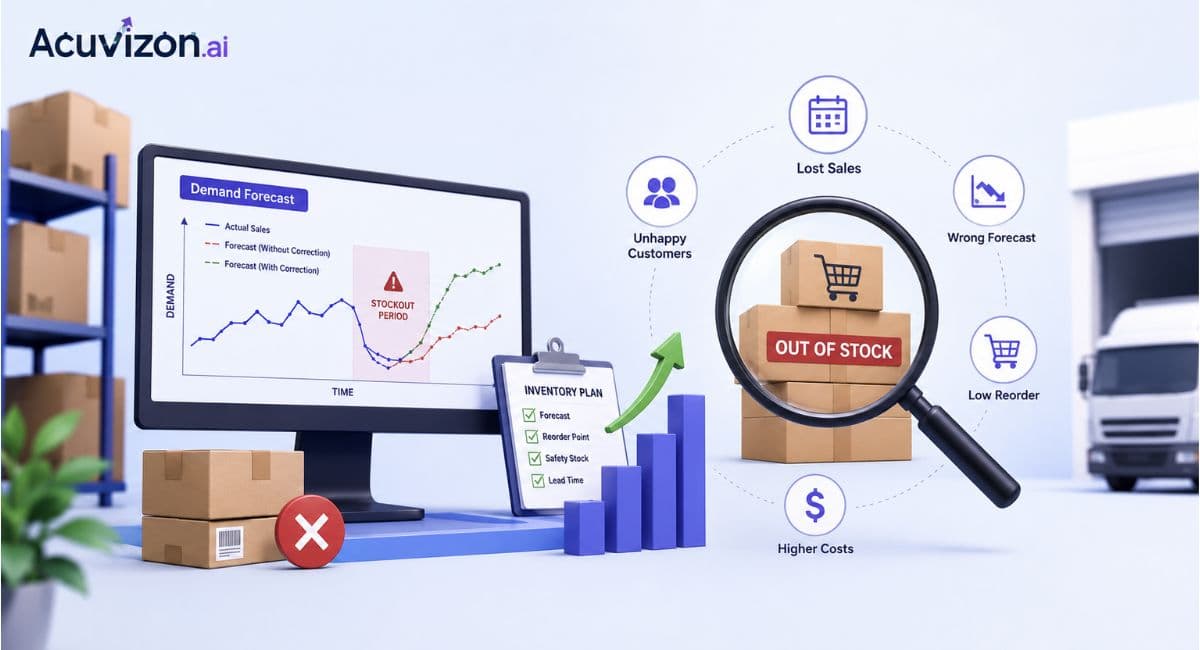
You sell out of a popular product. A new shipment arrives, and the product is back in stock. Your inventory forecast then tells you to order less than you did before.
That does not feel right. The product is still popular. People simply could not buy it while it was unavailable.
This matters when deciding how much to order. Low sales do not always mean low demand. In stockout demand forecasting, it is important to recognize when low sales are caused by unavailability rather than a real drop in interest. If a forecast assumes people do not want a product simply because it was out of stock, it can lead to under-ordering and another stockout.
Quick Answer: Do Stockouts Affect Demand Forecasting?
Yes. A stockout can distort an inventory forecast because the sales history includes days when the product was unavailable to buy. If a model uses raw sales data without recognizing unavailable periods, it may interpret lost sales as a drop in demand.
The correction is to identify periods when a SKU was not purchasable, exclude or reconstruct those periods, and use adjusted demand data rather than raw sales alone.
How Stockouts Distort Demand Forecasting
Most forecasts are based on past sales. This works when a product is always available. It breaks down when it isn't.
Consider a product that normally sells 12 units a day, then goes out of stock for 10 days. A forecast may interpret those 10 zero-sales days as weak demand, when customers simply couldn't buy the product.
This creates a cycle: a popular product sells out, records no sales while unavailable, gets forecast as low demand, gets reordered in a smaller quantity, sells out again sooner, and the forecast becomes increasingly inaccurate with each cycle.
The products most affected are usually the most important ones: strong sellers, repeat purchases, seasonal favorites, and heavily advertised items.
Sales numbers can look low even when demand is strong whenever a product isn't actually purchasable. Common causes include:
- A product available for pre-order but not yet purchasable
- A product not listed on the website or in a specific store
- A product out of stock in one warehouse but available in another
- A product removed from a website or sales channel
- Inventory held back for a specific order or promotion
- A product temporarily excluded from a collection or promotion
In each case, sales figures may be low even though demand is real. A forecast needs to account for this distinction.
Why Sales Velocity Becomes Misleading When an Item Is Out of Stock
Sales velocity is commonly calculated as units sold divided by days in the period. This works when a product is available every day, but produces a misleading number when it is not.
For example, suppose a product sells 200 units during the 15 days it is available in a 30-day month. Its true available-day velocity is roughly 13.3 units per day. If the calculation divides by all 30 days instead, including the 15 days customers could not buy it, the apparent velocity drops to about 6.7 units per day, roughly half the real rate.
If that lower figure feeds a reorder point, safety-stock calculation, or purchase-order recommendation, the business may under-order its next replenishment. This is why out-of-stock sales data should not automatically be treated as demand data.
How to Correct Demand Forecasting After a Stockout
There is no single fix, but a few steps consistently help:
- Identify when a product was unavailable, whether due to being out of stock, unlisted, or otherwise unpurchasable
- Separate days when a product did not sell because it was unavailable from days it simply did not sell
- Base the forecast on sales from periods when the product was actually available, not on the full raw sales history
Why Correcting Stockout Data Is Hard Retroactively
Correcting forecasting with missing sales data depends on what historical availability information exists.
Sales history typically shows when orders were placed, but not always whether a product was available every day it did not sell. Inventory history, channel availability, listing status, and warehouse-level stock all matter.
A business that begins recording daily inventory position today builds a stronger planning record for future forecasting. Without that history, it can be difficult to distinguish a genuinely low-demand day from an unavailable day months or years later. This is one reason to connect forecasting and inventory planning systems early: the value is not only in today’s recommendation, but in building a more accurate history for future planning cycles.
Questions to Ask Your Inventory or Forecasting Provider
Before relying on a forecast for purchasing decisions, consider asking:
- Does the forecast account for periods when a product was unavailable?
- Can the system distinguish an unavailable product from one customers simply do not want?
- Does the system track inventory levels over time?
- How does the system handle pre-order products, unlisted products, and similar situations?
- Can the inventory planner adjust the forecast if it appears inaccurate?
- Does the system factor in supplier lead time and appropriate safety stock levels?
The answers can help determine whether a forecast is reliable enough to guide purchasing decisions.
How Acuvizon AI Handles Stockout-Affected Demand
Acuvizon AI helps ecommerce teams make inventory decisions by identifying when a product was unavailable and factoring that into the forecast. It also accounts for inventory levels, demand signals, and other factors that can affect accuracy.
The goal of Acuvizon AI is to help teams avoid stockouts and keep the right products in stock. For more on forecasting, safety stock, reorder points, and related topics, see Ecommerce Inventory Planning and Replenishment.
Frequently Asked Questions
Do stockouts lead to inaccurate demand forecasts?
Yes. If a forecast treats unavailability as weak demand, it can lead to under-ordering and a repeat stockout.
Should out-of-stock days be included in sales numbers?
Usually not. Including them can make sales figures look lower than they really are and understate true demand.
How do you forecast demand after a stockout?
Identify when the product was unavailable and use that information to adjust the forecast. Sales from comparable periods, seasonality, and other demand signals can help fill the gap.
Do stockouts affect reorder points?
Yes. A forecast that understates demand can lead to a lower reorder point and another stockout sooner than expected.
What is the next step after identifying stockout-distorted demand?
Review demand rate, safety stock, supplier lead time, and reorder point together so the correction carries through to the next purchase order.