How to Forecast Demand for New Products
Most forecasting tools need six to twelve months of sales history. New colors, flavors, and seasonal drops do not have it. Here is how to forecast demand before any history exists.
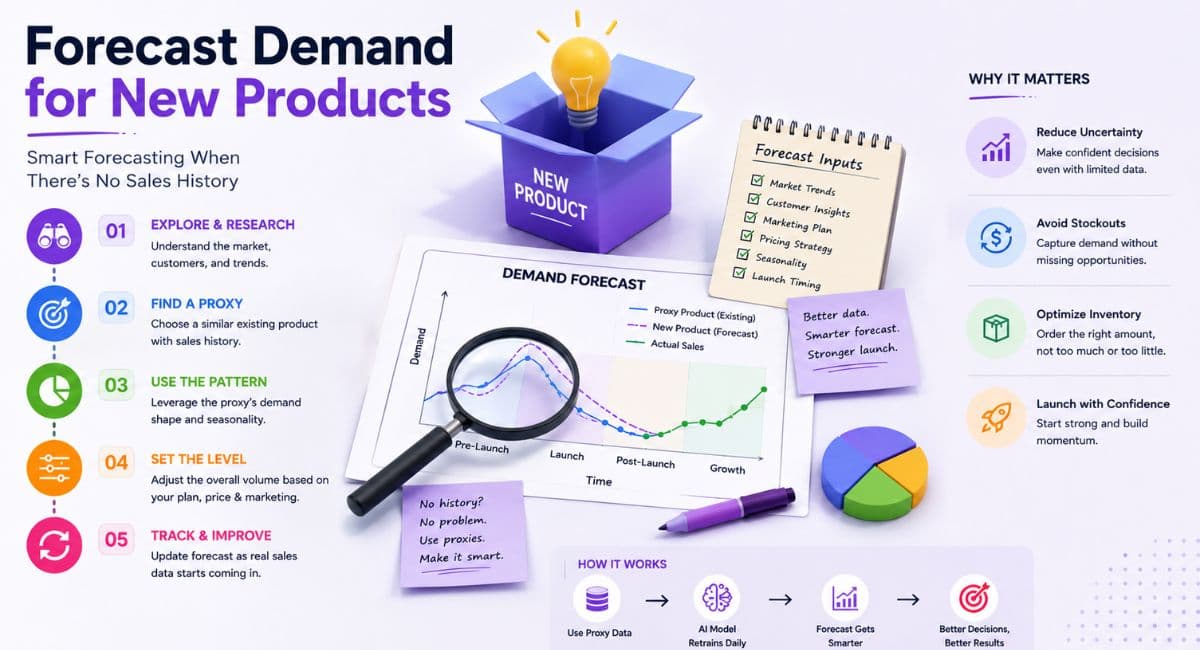
Forecasting New Products When There Is No Sales History
Most demand forecasting tools need six to twelve months of sales history before they produce a reliable number. That requirement does not disappear just because the module is bundled inside a larger platform. The forecasting engines built into major ERPs carry the same constraint.
New products don't have that history, and that is a problem, because new products are usually where growth and risk in a catalog concentrate. A new color, a seasonal flavor, or a limited drop are exactly the SKUs a merchant most needs a confident number for, and exactly the SKUs a history-based forecasting tool goes quiet on.
Why It Is the Hardest Ordering Decision You Will Make
Four pressures stack up the moment you order a brand-new SKU:
- No history to extrapolate from
- Often the largest single order for that SKU, since the first purchase order sets the opening position
- Frequently a one-time buy, so there is no chance to correct a bad first guess.
- The decision happens months before launch, driven by supplier lead time rather than any demand signal.
This is where generic cold-start demand-forecasting advice breaks down. The problem is not that the forecasting math is too simple; it is that there is no data for any math to run on. Solving it means changing the approach, not upgrading the model.
Proxy Forecasting: Borrowing the Shape of Demand
The practical answer is proxy forecasting: finding an existing product whose demand pattern is close enough to lend its shape to the new one.
- Same product, new variant: a hoodie in a new color inherits the existing hoodie’s size distribution
- Same category, new item: a new flavor inherits the demand curve of the closest existing flavor
- Category average: the fallback when nothing closer exists
What matters most is the ability to choose the proxy deliberately rather than accept a default average. A merchant who knows their catalog can usually pick a better comparison product than an algorithm defaulting to a category-wide blend.
What a Proxy Can and Cannot Tell You
A proxy carries the shape of demand, such as the size curve and seasonal profile. It does not carry the level, or absolute volume, since that depends on marketing spend, pricing, and launch timing. Use the proxy to set the distribution, set overall volume from business judgment, and correct quickly once real orders come in.
The Launch Spike Problem
Launch demand often does not repeat in the pattern it first appears in. A typical shape is a spike from an existing email list and social following, a trough once that initial interest fades, and a settled baseline meaningfully below the spike.
Forecasting forward from the spike leads to significant over-ordering. Treat the launch period as its own phase, separate from the ongoing replenishment forecast.
One-Time Purchases That Cannot Be Corrected Later
Limited editions and exclusives do not get a second chance. A corrected forecast is worthless once the ordering window has closed. For these, the useful question is the range of likely outcomes at the point of commitment, and the asymmetry between ordering too few (lost sales) and too many (markdowns and tied-up cash).
What Acuvizon AI Does
New products in Acuvizon AI start with a category default, but you can assign a specific SKU as the proxy instead. The model retrains daily, so real sales data progressively replace the proxy assumption as it comes in.
Frequently Asked Questions
How do you forecast demand for a product with zero sales history?
Use proxy forecasting: borrow the demand shape from a comparable existing product, then set overall volume based on business judgment, such as the marketing plan and launch scale.
How much history do forecasting tools usually need?
Roughly six to twelve months of transaction history. New products, by definition, do not have that history when the ordering decision must be made.
What is the biggest mistake merchants make when ordering a new product?
Treating the launch spike as the ongoing run rate, which leads to significant, avoidable over-ordering.